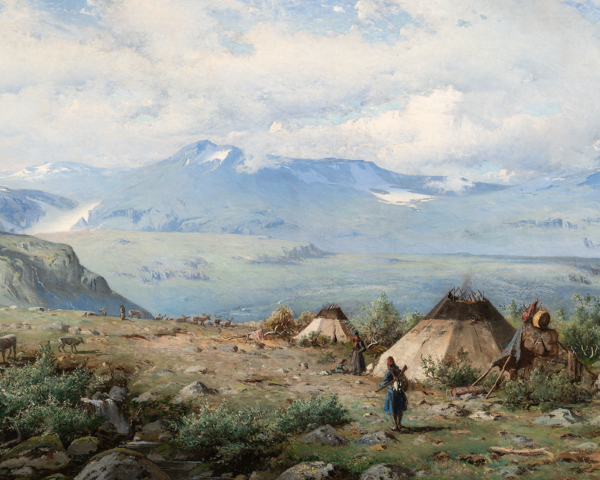
The exhibition explores a period of transformation in Nordic painting spanning the mid-nineteenth century to the early decades of the twentieth.
During this period, many Nordic artists travelled to and studied abroad in Paris, where they encountered emerging languages of modern art. These experiences informed a broader cultural shift associated with National Romanticism, where the influence of Symbolism and Impressionism provided Nordic artists with new means through which to expand the boundaries of naturalist painting and reconsider the expression of national identity.
Where earlier Nordic art often emphasised the faithful depiction of landscape and the sublime character of nature, this generation increasingly filtered their surroundings through personal perception and cultural atmosphere. The exhibition traces this development, through oscillations between mimetic depiction and a more subjective approach to form, light, and tone. Situated between Naturalism and early Modernism, the artworks reveal a fluid tension between observation and interpretation. The result is a mode of expression characterised by a compelling push and pull between tradition and artistic experimentation.
Artists on view such as Akseli Gallen-Kallela and Hugo Simberg exemplify this synthesis, integrating mythic and symbolic content into distinctly Nordic settings, while Olof Johan Grafström exemplifies a more mimetic approach to capturing the northern reaches of Europe. Gallen-Kallela’s View of Lake Ruovesi (1923), painted shortly before his family’s move to America, shows the artist capturing the serene nature surrounding his studio with a sense of expressionist playfulness. The work is bathed in lush warm colours – the autumnal sun’s rays ephemerally held by the vegetation in the foreground. Gallen-Kallela creates a skilful contrast between the thick brushstrokes of the body of water and the sky, separated by an evergreen forested horizon-line, and the delicately rendered thin branches and withering leaves clinging onto the warmth and light of the rapidly decreasing evenings.
Hugo Simberg’s The Model Warming Up is an extraordinary representation of the artist’s wife Anni Bremer taking a break between sitting for portraits. Bremer is naked mid-bow over a minuscule stove as if paying obeisance to the heat, a heap of black clothes temptingly in reach. The coldness of the room is palpable; her marble-coloured skin is highlighted by hues of blue on her legs and a feeble reddish tinge on her hands – divulging the Sisyphean task of the heater. The painting features a quadrant of negative space painted in rich earthy colours, imbuing the scene with a complex geometrical depth that suggests a deliberately devised setting beyond the frame.
As such, the present painting gives the viewer an insight into the spontaneous and natural beauty of daily life in the house of the painter.
These two highlighted works exemplify the breadth and nuance of Nordic painting at a moment of profound artistic and cultural reorientation. The dialogue between artistic expression and mimesis in Colnaghi’s upcoming exhibition will enable the viewer to find both striking similarities and differences between the artists’ approaches surrounding the turn of the century.